
A summary of this piece appeared in Hobart’s The Mercury as an OpEd ‘Talking Point’ on 1/7/2026. [This post first published on Substack on July 2nd 2026]
Executive Summary
- Qualiteach – DECYP Tasmania’s online teacher professional development in literacy initiative – was built on WordPress, which is a free content management system. The Learning Management System integrated with the WordPress installation is publicly available for US$800p.a. Despite these low IT costs, Qualiteach cost Tasmanian taxpayers $1.2 million, which represents nearly 20% of the total the Premier initially announced to fund the Lifting Literacy recommendations over four years (or around 75% of one year’s allocation).
- Given this discrepancy, one could reasonably expect that the bulk of the costs were due to the creation of the PD content itself. However, the quality of the content attracted immediate criticism within literacy circles, which is perhaps unsurprising given Deakin University – the content provider – lacks a track record in the structured literacy space. Problems included:
- Definitional errors of fact
- Omission of important information
- A general sense of ‘waffle’, rather than explicit instruction
- Poorly constructed quizzes (which apparently resulted in leadership circulating answers so teachers could progress)
- Content has been/is being revised as a result of post-launch appointments (costing taxpayers again).
I’m calling for the Lifting Literacy Outcomes Monitoring Group (LLOMG) to flag the necessity to seek explanations of how this project cost so much given the low software cost, and how the content missed the mark so badly.
The long read.
Soon after it was released, I started hearing quite a lot of negative chit-chat about Qualiteach, the mandatory online professional development course that emerged as one facet of the Lifting Literacy rollout. I wondered if it was due to genuine issues or due to resistance to a perceived ‘jumping through hoops’, so I was keen to see it.
I was given a login to check out the content, and having recently finished wading through as far as I’m willing to on my own time, I feel like I’ve got a pretty good feel for it.
I’d held some hope for Qualiteach, not only because it was a system-wide tool being developed from the ground up to fill the gaps in ITE (Initial Teacher Education), but also because, well, it’s not that hard to communicate the necessary information about quality literacy instruction.
Or so I thought.
Ground up development
Arguably, the fact that it was being developed from the ground up should’ve been a red flag, not a reason for hope. I say this (as an ex-IT consultant) because reinventing the wheel is often (usually?) not a good idea where IT projects are concerned, largely because of the nature of IT projects. That’s a post in itself, but for now I’ll just note that IT projects are frequently exorbitant, under-estimated in terms of complexity (both by the purchaser and – due to the purchaser’s unrealistic timelines – the vendor), and, due to their relatively arcane nature, opaque and therefore beyond scrutiny. But, even so, as far as IT projects go, a bunch of mandatory training modules is one of the least demanding projects you could work on, given that LMSs (Learning Management Systems) have been around for decades. That is, the IT is not actually being built from scratch, only the course content (and only the course content if you don’t just buy it pre-packaged from a trusted provider – which is certainly another option).
In fact, with a two-minute inspection of the wesbite’s code, it’s clear Qualiteach is a WordPress site. This means the core software cost = $0. It has a publicly accessible (at time of writing) default administrator login page (far from best practice in terms of security). The LearnDash LMS (Learning Management System) WordPress plugin is running on the site to provide the LMS (software available from US$600 p.a.) There’s likely to be a few more plugins bolted on, but the core ‘engine’ cost of this development would appear to be negligible.
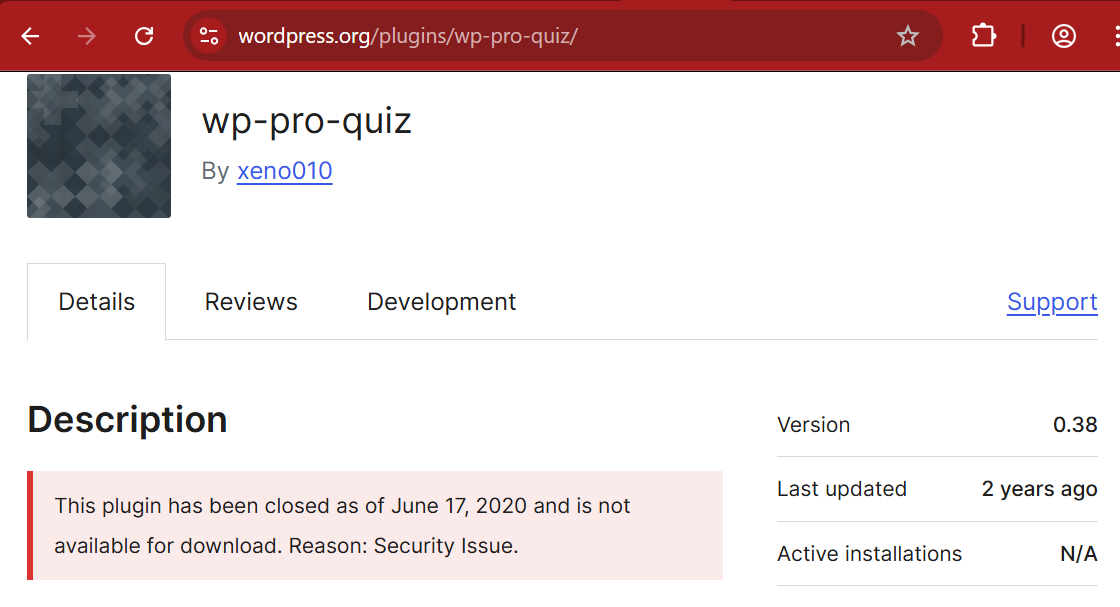
And there’s nothing wrong with that. There are lots of Fortune 500 companies who run WordPress websites. It’s a mature product with a team of gun developers behind it, although the third-party plugins are typically much less stable, and sometimes come bundled with legacy security issues (for example it looks like LearnDash is using a discontinued-due-to-vulnerability plugin called WP-Pro-Quiz to handle the quiz component of Qualiteach – but it’s possible they’ve dealt with any issues, or have even effectively redeveloped their own version of it, or that it’s a completely different plugin with a similar name; all very possible within the WordPress environment).
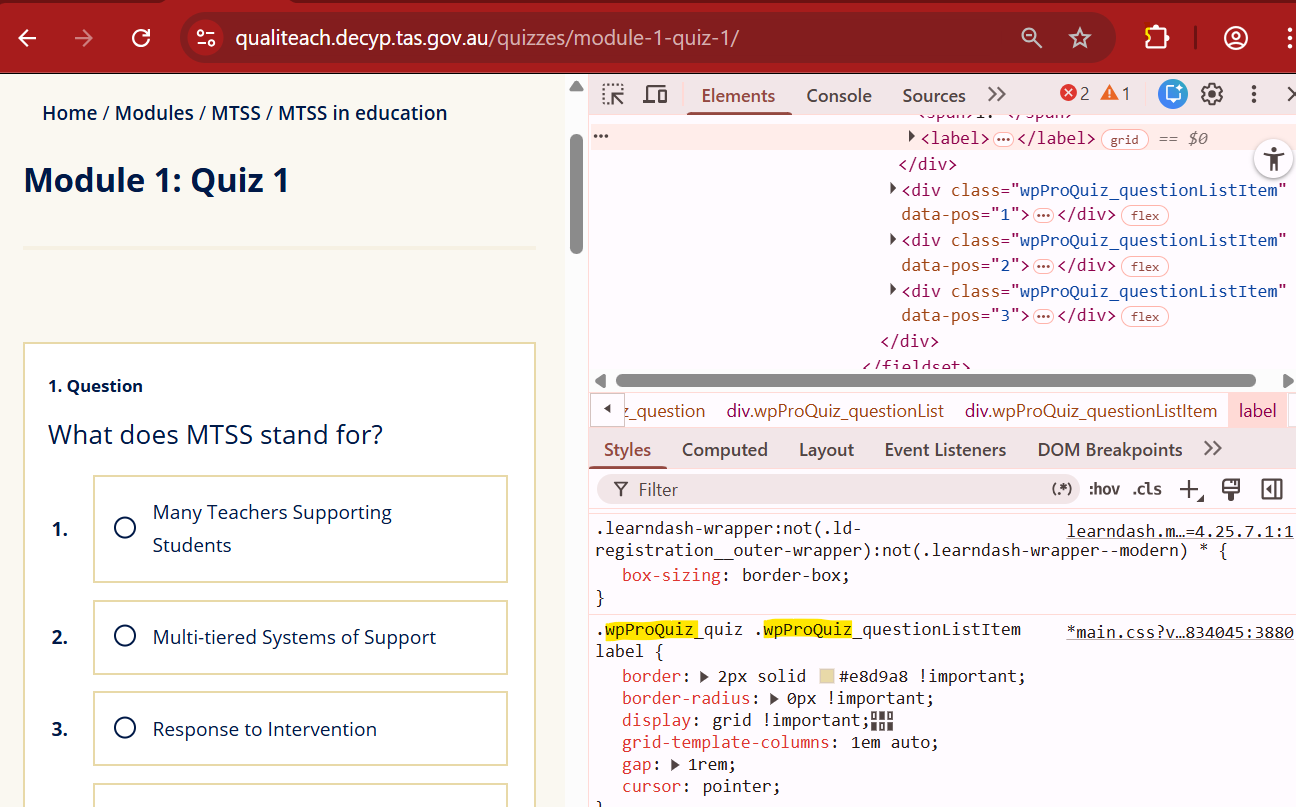
At one point I even logged in to find I had DECYP Administrator rights to Qualiteach, which left me with the names and email addresses of more than 11,000 users at my fingertips, which certainly shouldn’t have happened.
But I digress. The point here is that the software doesn’t cost much. Which, given the price tag of:
$1,210,253.09 (yes, really)
…makes you think there must’ve been an awful lot of time put in by Deakin University to develop the course content, because the developers at Grindstone Creative surely wouldn’t be padding out their costs that much. Even with the overheads of running a business and building in some “Woohoo!! Government contract!!!!” fat, I’d like to think that the number crunchers would’ve reined in the largesse potential a bit, due to social conscience around the importance of developing a literacy package for the State with the worst historical literacy outcomes in the country, and a now-spiralling budget deficit. Code REaD Dyslexia Network’s commissioned report from Equity Economics argued that governments can reap a thirteen-fold return on investment by spending on literacy reforms, but to get that RoI, those reforms have to be based on a sound understanding of the research behind literacy acquisition. Qualiteach does not appear to be one such reform, because…
Conflated content
I have completed – out of personal interest and ‘community service’ with my Code REaD hat on – the first 11 modules that go through to the end of year 2 schooling. I have passed on feedback to the Lifting Literacy folks over several months last year, so some corrections have likely been made; quite frankly, I am never getting those hours of my life back and I am not going to spend a similar amount of time checking to see what changes have been implemented, because it was quite a disheartening experience. As such, what you see here may (hopefully) not reflect the current state of Qualiteach (at a quick look, it does seem to me that changes have indeed been made, but some ‘corrections’ seem to have dug a deeper hole – some of which are included here).
The language of the modules is a strange mix of didactic and constructivist-reflection-inviting. Explicit instruction fans were keenly aware of the irony of Qualiteach training modules about explicit instruction winding up with invitations to partake in collaborative inquiry to reflect with other staff members. But I can pretty much ride that wave, and perhaps even (generously) view it as a way of easing teachers into a new way of looking at things by carrying over some old habits for comfort. Qualiteach’s ‘tone’ is certainly less than ideal in terms of succinctly delivering what teachers need to know, and more like a continuation of philosophical navel gazing.
And the actual content left a lot to be desired. Indeed, on several occasions I’ve found myself trying to fathom whether these Qualiteach ‘definitions’ of core principles have been created by an evil genius trying to undermine the entire project, or by someone who has just enough knowledge to be accidentally dangerous. This post is a sampling of some of the more troubling stuff, with my critique. I’ve run this past Hobart psychologist and specialist literacy tutor, Michelle Chadwick, to ensure I’m not just saying crazy things. Michelle has reviewed, encouraged some massaging of the text, challenged my thinking, added some more points, and in one case made me realise I had to dig deeper to justify my views.
Orthographic Mangling
Spending the first few minutes poking around in Qualiteach, this is the first statement that really slapped me across the face:
For example, take the simple word ‘cat’, with its clear onset (‘c’) and rime (‘at’). Learning this will help students read other words in this ‘word family’ such as ‘mat’, ‘bat’ and ‘sat’. This process is referred to as orthographic mapping.
“Let me count the ways” this is messed up.
- This is not what orthographic mapping is. Orthographic mapping is involved in the process of learning “cat”, but nothing in this statement comes close to defining what orthographic mapping is. Orthographic mapping is the partially-understood mnemonic process by which sounds, spellings and meanings are linked through exposure, to form long-term memories of words.
- Orthographic mapping is perhaps involved in the suggested ‘transference’ of greater ease in reading other words as suggested here, but the described learning in this statement is more likely an artefact of priming effects. Putting it simply, this statement is a conflation, at very best. Teachers assuming this was an accurate definition, would’ve been done a terrible disservice.
- Teaching onset and rime units is generally considered relatively ineffective (compared to phoneme-level instruction). This Qualiteach statement doesn’t actually explicitly encourage such teaching, but by breaking “cat” into onset and rime, and then saying “Learning this…”, it certainly encourages onset/rime teaching at least implicitly. Again, for teachers uninitiated with the research, this would be leading them down the wrong path.
- The same applies to ‘word families’.
- Orthographic mapping involves sound (the focus of the Qualiteach ‘definition’), spelling (not really explicitly mentioned in this definition – since a rime can be spelt in different ways), and meaning (omitted entirely from this definition). The research shows we are much more likely to successfully spell and read a word if we know what it means. That’s critical information for instruction, and it’s the kind of rare, directly useful, practical translation of research-to-practice information that should feature heavily in teacher professional development. But Qualiteach omits it altogether, and instead seems to be offering a word-soup that simply sprinkles key terms from the research. The opportunity to translate a research gem was lost here.
- As a counterpoint to what appears to be the main thrust of this statement (that priming kids with rime units is somehow orthographic mapping), you could also argue for ‘interference’ effects caused by that priming: give beginning or struggling readers cat, mat, rat, and then put ‘sad’ in front of them and some will read it “sat”. But I digress…
Summary: if you don’t know what orthographic mapping is, you shouldn’t be writing course content on literacy instruction. (I’m looking at you, Deakin).
Four main bodies of research into reading
Under this heading, the Simple View of Reading, Scarborough’s Reading Rope, Cognitive Load Theory and The Active View of Reading are listed.
The implication there seems to be that this is the “main” research into reading.
These concepts barely scratch the surface of the actual body of reading research. It says nothing of eye-tracking research, activation research with MRI, brainwave research using EEG, reading process models, temporal processing research, proprioception research, orthographic processing research, response times research into priming and interference, instructional methods research… the list goes on.
Those four “main” bodies of research are important concepts, but knowing them doesn’t make someone a good literacy teacher.
The Simple View of Reading
Qualiteach originally stated:
“The Simple View of Reading model serves as an overview. It emphasises the main components that you need to focus on when teaching students to read across learning areas.”
Actually, that’s exactly what the authors of the SVR, Gough & Tunmer, said it doesn’t do. They explicitly stated:
We begin by noting that the issue we wish to discuss is not that of the place of decoding in reading instruction… (emphasis in original)
Note also that comprehension instruction is not mentioned at all in the SVR article. In contrast, if you take this Qualiteach statement at face value, it’s suggesting the SVR emphasises that half the weight of the input into reading comprehension is oral language comprehension instruction. The SVR authors were at pains to explain why (despite the obvious potential implications) decoding instruction isn’t the point of their article, but they didn’t explain why instruction in oral language comprehension isn’t the point; it almost seems to have not entered their minds that they’d be understood as making such a recommendation. And yet, that’s what the Qualiteach authors did with it.
There’s also a Venn diagram which is arguably worse than useless: not only does it have the area of commonality unlabelled, a Venn diagram is a singularly inappropriate visual explanation for what was expressed as a simple multiplication sum (decoding x language comprehension = reading comprehension). This is not an equation about overlaps, it’s about two unique and entirely separate skills resulting in a product. Why is it depicted as a relationship of commonality? And why is the language comprehension label impinging onto the word recognition circle? It looks like the Qualiteach authors don’t know about the SVR or Venn diagrams.
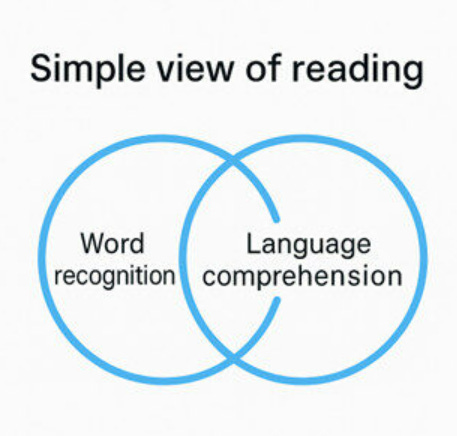
Again, it seems the Qualiteach content authors have only the shallowest acquaintance with the research. It is, of course, important to teach decoding and to build language comprehension, but that’s not what the seminal SVR paper argued (the authors discuss this nuance in the paper itself).
Speech & Language Mythology
Once again, the level of actual knowledge on a topic is exposed in statements like this one (under the heading “Voiced or unvoiced”):
The final thing to understand about the production of phonemes is that phonemes can be voiced or unvoiced. Some phonemes are made in the same place and in the same manner, but the difference is that they are either unvoiced (just made by air) or voiced (air and voice are used to produce the sound). These are often called minimal pairs and include:
- /f/ as in fan and /v/ as in van, /f/ is unvoiced and /v/ is voiced…
- /t/ as in ten (unvoiced) and /d/ as in den (voiced).
- /p/ as in pay (unvoiced) and /b/ as in bay (voiced).
- /c/ as in coat (unvoiced) and /g/ as in goat (voiced).
- /th/ which can be unvoiced as in this and voiced as in that.
- /s/ as in peace (unvoiced) and /z/ as in peas (voiced).
Let me count the ways…
- Minimal pairs, as described in linguistics and speech pathology, are not phonemes. They are words.
- Contrary to what uninitiated teachers might glean from this statement, minimal pairs do not only exist as words that differ due to phonemes being voiced or unvoiced. Whether phonemes are voiced or unvoiced in words in a word pair is not necessary (but may be sufficient) for a pair of words to constitute a minimal pair. That is, “fan” and “van” are indeed minimal pairs, but so are “fan” and “pan” (and both onsets here are unvoiced), while “fan” and “vat” are not minimal pairs (because they differ by more than one phoneme).
- Contrary to the example in Qualiteach, /”th”/ is actually voiced in both “this” and “that” (compare to “thumb”, in which /th/ is genuinely unvoiced).
- Even if “this” and “that” did feature unvoiced and voiced ‘th’ respectively, the words “this” and “that” would still not be minimal pairs (while “that” and “hat” are).
Points 1 & 2 here are far more concerning (and give rise to point 4). A statement that words (not phonemes) differing only by an unvoiced and voiced variation of a phoneme are minimal pairs would be, strictly speaking, true, but if it’s the first time teachers have been introduced to the term, they’re more than likely going to form an incorrect understanding: assuming that the noted characteristic of a sub-set defines an entire set.
Putting it another way, introducing minimal pairs in this way is akin to trying to introduce irregular verbs by saying:
“ew” is often called an irregular verb, while “ed” is a regular verb, as in “jumped”, “landed”, “sailed” (all are regular) vs. “grew”, “flew”, “knew”, “drew” (all are irregular).
That sounds absurd to anyone who knows about irregular verbs, but it’s not that much of a stretch of an analogy. It’s not perfectly logically equivalent, but it does feature some logical equivalence: my statement incorrectly calls part of a verb the verb (which is the first error in calling a phoneme a minimal pair: calling part of a minimal pair the minimal pair), and it also neglects to mention other ways an irregular verb could be constructed, such as by the “ought” in “thought”, as well as the fact that “ew” needn’t denote an irregular verb (as in “new”). Further, my irregular verb ‘definition’ does include some verbs that are irregular, but that doesn’t make my definition correct, just as Qualiteach’s ‘definition’ of minimal pairs does include some minimal pairs, but the definition is still inaccurate.
In short, the Qualiteach statement on minimal pairs is likely to be as troublingly ‘loose’ to anyone who uses minimal pairs as a therapy tool, as my analogous statement on irregular verbs is to anyone who teaches irregular verbs. More to the point, teachers will come away from the ‘definition’ of minimal pairs with incorrect knowledge, just as a teacher who knows nothing about verbs and reads my definition of verbs, will come away with an incorrect notion of what a verb is.
Beyond the minimal pair conflations, the level of detail provided in Qualiteach for place and manner of articulation of phonemes is, in my opinion (as someone who tutors in a speech pathology clinic) overkill. It’s useful for teachers to have some knowledge about this, to be able to identify children who are having difficulties with speech production/recognition, but unless we actually want teachers to be training as speech pathologists, I do not see the point in covering terms such as alveolar, velar, uvular… More on this (and the utility of teaching kids terms like “fricative”) to come in another post.
Phonemic unawareness
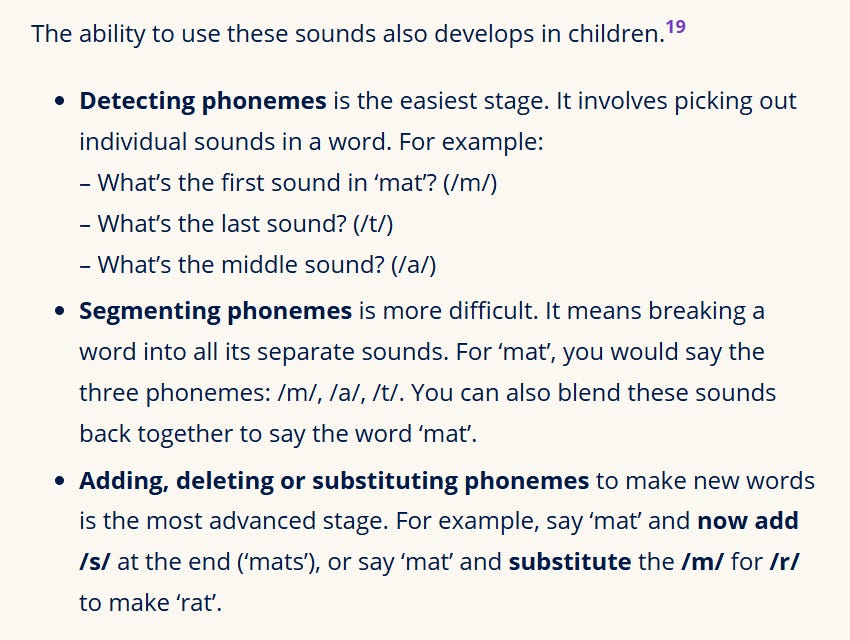
- The ability doesn’t develop, it is learned (either implicitly or explicitly). That’s why we need to train it explicitly – to get the ability happening faster.
- Strictly speaking, you don’t segment phonemes. You segment words into phonemes.
- ‘Detecting’ the middle sound /a/ in “mat” first involves segmenting the word “mat” into phonemes, but this explanation treats them as entirely separate processes in two different bullet points.
- Segmenting and blending are different skills (the former for spelling, the latter for reading) and yet they’re both discussed under the ‘segmenting’ dot point (while ‘detecting’, which does involve segmenting, gets its own dot point).
- There’s raging debate about the utility of ‘advanced’ PA skills (i.e. adding, deleting, and substituting phonemes, as in the last dot point). They certainly don’t need their own dot point, if blending doesn’t get its own.
The Alphabetic Runcible
I refer here to the runcible spoon – the invented adjective from The Owl and the Pussycat which has since effectively become an actual word through usage. I reference this because Qualiteach’s treatment of the alphabetic principle has been similarly invented and has caught on too. In fairness, the Qualiteach authors appear to have lifted most of their content on this section from Buckingham, Wheldall & Wheldall – typically rock solid sources – but as I’ve contended at length elsewhere, the notion of the ‘alphabetic principle’ has strayed a long way from its origins into the realms of being a category error (and caught on in that form), and Qualiteach has stretched it beyond its limit and is baking it in.
Qualiteach seems to have taken this error to extremes and considers pretty much anything to do with an alphabet (e.g. names of uppercase and lower case letters) to be a defining characteristic of the alphabetic principle (which certainly, in the earlier concepts of the alphabetic principle, had nothing to do with it).
“It made me feel so stupid”, is feedback I heard from one teacher about Qualiteach. Given how this alphabetic principle has been mangled, miscategorised, extended and almost mysticised, I’m answering, “you’re not the problem here”.
Morphologyoyogy
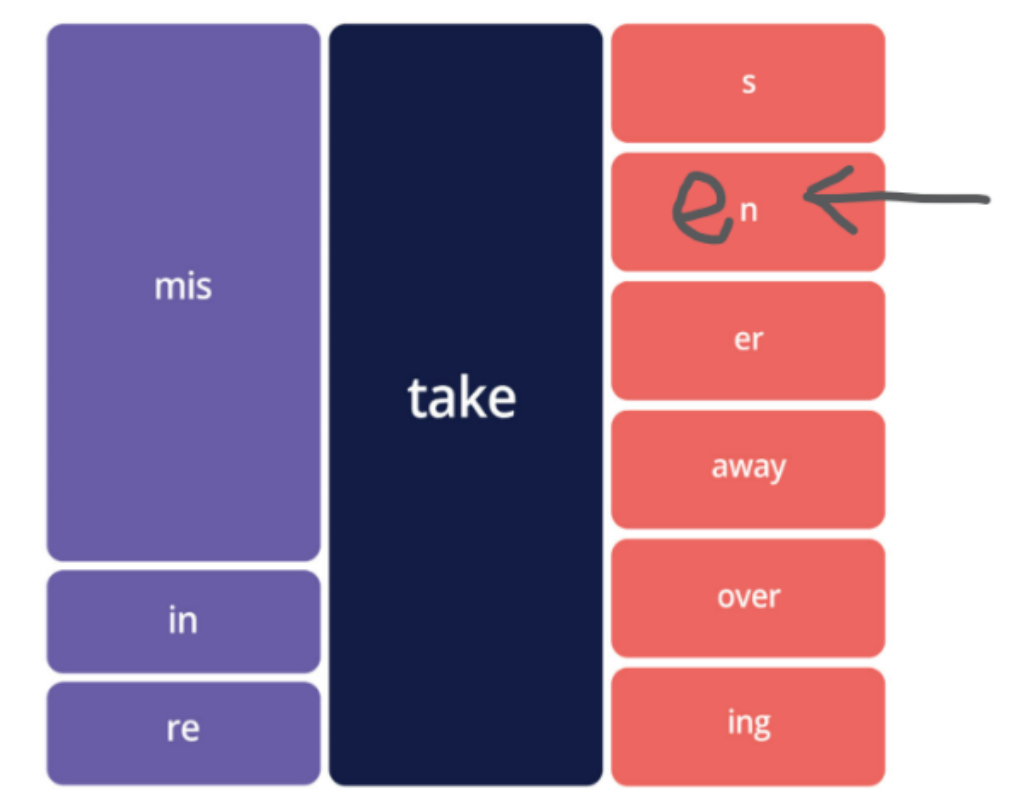
No, “n” is not a suffix.
Phonological redundancy
Qualiteach challenged teachers to count the phonemes in “egg” and “eight”, to support a point:
“As students begin to rely more on their orthographic lexicon to read words, phonological and phonemic awareness skills become redundant as they are seldom used. Thinking about phonemes especially for competent readers and writers may be difficult… There are two sounds or phonemes in the word [egg] /e/ and /g/ even though we know that the word egg has three letters. Now do the same for the word ‘eight’. How many sounds did you count?”
Phonological and phonemic awareness skills don’t become redundant, they become automatised. These are very different. Saying they become redundant is like saying hand-eye co-ordination skills become redundant for an expert driver.
The difficulty in thinking about phonemes is not due to reading expertise, but due to the fact that it’s a naturally implicit spoken language skill, not an overt skill. Challenging teachers (who were likely never trained in phonemic awareness themselves as children) to count the number of phonemes in “egg” or “eight”, does not demonstrate that competent readers find counting phonemes difficult – any difficulty demonstrates that teachers had not been trained to identify phonemes and likely haven’t been trained in grapheme-phoneme correspondences either (such that ‘eigh’ may appear to be more than one phoneme, because of its four letters).
Brain activation under fMRI in a skilled reader shows that phonological information is still being processed even when the reading is silent – it’s automatised, not redundant.
Suggesting that it’s redundant (and using teachers’ own inability to easily identify phonemes as evidence that it’s redundant for competent readers) risks it being bypassed by teachers who ‘deep down’ don’t believe PA is a necessary skill (which, for some, it’s not, as an explicitly-taught skill, while for others it’s essential).
Quizzing quizzes
I generally detest multiple choice quizzes, but the Qualiteach quizzes were a special level of hell. In addition to errors, some were so poorly constructed that it was a mission to find any correct answer, and in others, to find any incorrect answer (where required), and in others still, I really had to think about what level of knowledge I was being tested on, in order to choose the ‘right’ answer. I heard through the grapevine that DECYP actually started circulating the answers so teachers could move through the quizzes.
Here’s an example of one of the few questions I got wrong (I chose 3, while 2 was the answer they wanted):
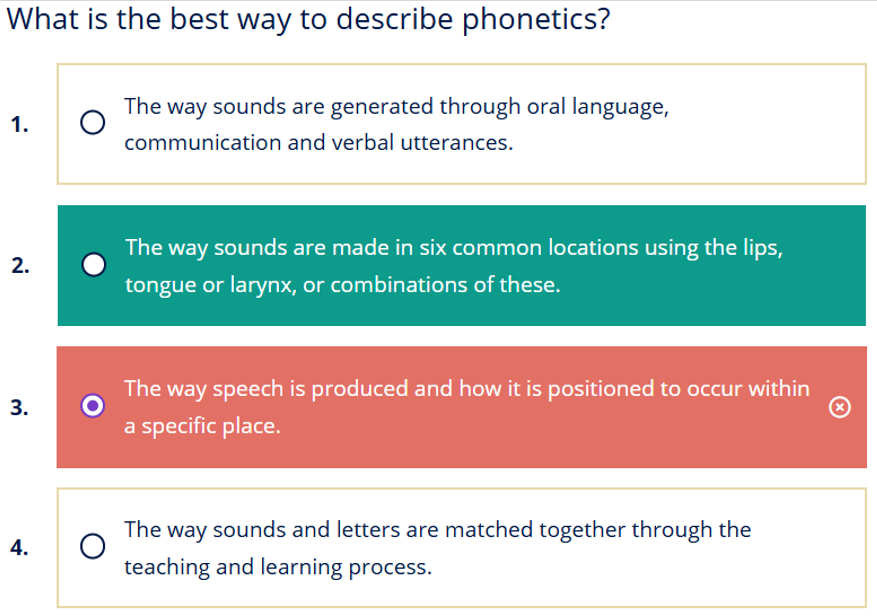
Phonetics is the study of speech sounds, not sounds. We can make all kinds of sounds, but they may not be used in speech. Only speech sounds are studied in phonetics. So, because 3 mentioned “speech” and 2 didn’t, I chose 3. Also, I thought, what does “common locations” (in 2) mean? Is it worded to imply that there are also uncommon locations of speech production, alternate to these 6 common locations?
And what is actually wrong about 3? Is it that it talks about “a specific place”? Is that wording meant to be implying that this answer is saying all sounds come from just one single location and not 6? Because if that’s what’s supposed to make the answer wrong, then it should be explicitly wrong, not implicitly.
You can see how people would struggle with these gymnastics. One more for the road:
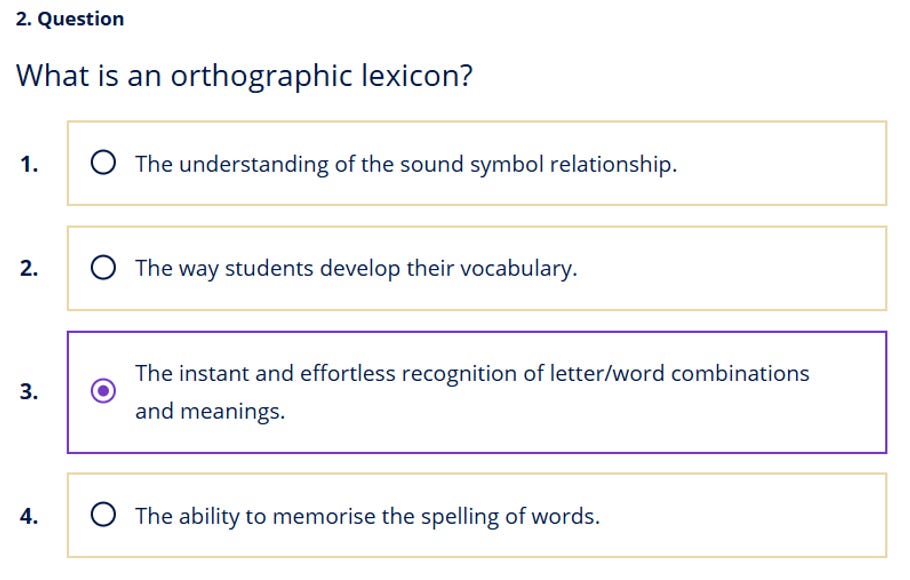
This answer was correct, but it shouldn’t have been. Lexicon is a noun, while recognition relates to a verb. A lexicon enables recognition, but it isn’t recognition.
Random wrong stuff
A sampling of some stuff that struck me as ‘off’.
- In the vocab section, Qualiteach stated “Tier 2 words contain more sophisticated and subject-specific words (e.g. half, healthy, huge, important, float).” This looked like a conflation of definitions and, when I followed the references, I confirmed it is factually incorrect. The reference provided for this definition of Tier 2 words isto Fellowes’ & Oakley’s Language, Literacy, and Early Childhood Education, whichactually references Beck et al’s 2002 definition. This text states that it is tier 3, not tier 2 words, which are subject-specific. The associated quiz for this point was also penalising the correct answer.
- The intro to module 5 mentioned “morphology (smallest parts of words)”. This is like some nested irony wrapped in a conflation… the most meaningful part of the definition about the smallest meaningful parts of words is omitted – meaning. And that’s actually the definition of a morpheme, not of morphology, which is the study of the smallest meaningful parts of words.
- “This module focuses on language the subsystem of phonology, the study of sounds within a language.“ Good luck parsing that one. It’s one of many mind-bending sentences that make you feel like you’re being gaslit. I’ll leave that class of problems with just that shining example.
- “For tricky, high-frequency words that break the usual sound–spelling rules – words like ‘the’ and ‘said’ – it’s best to simply teach learners to recognise this small set of irregular words on sight.” Grrrr. A later module also looks at high frequency word instruction and includes far more useful and accurate information, but still makes no mention of using etymology or the phonetic hook of “spelling voice”.
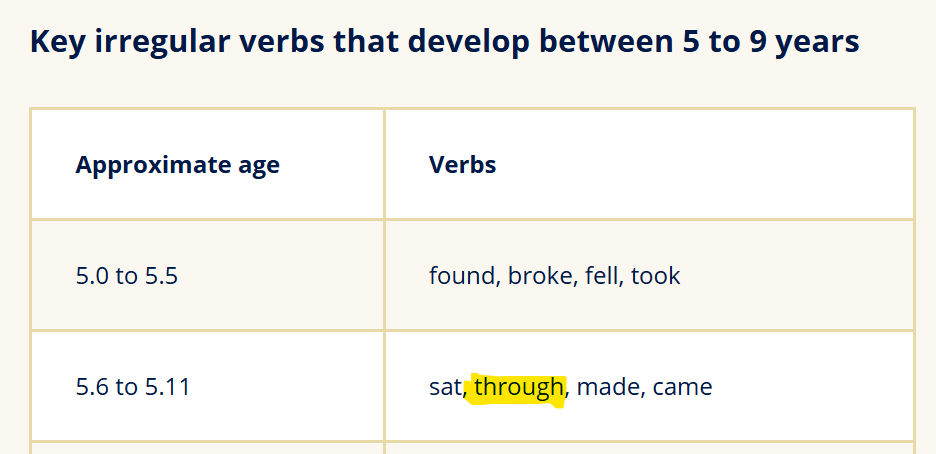
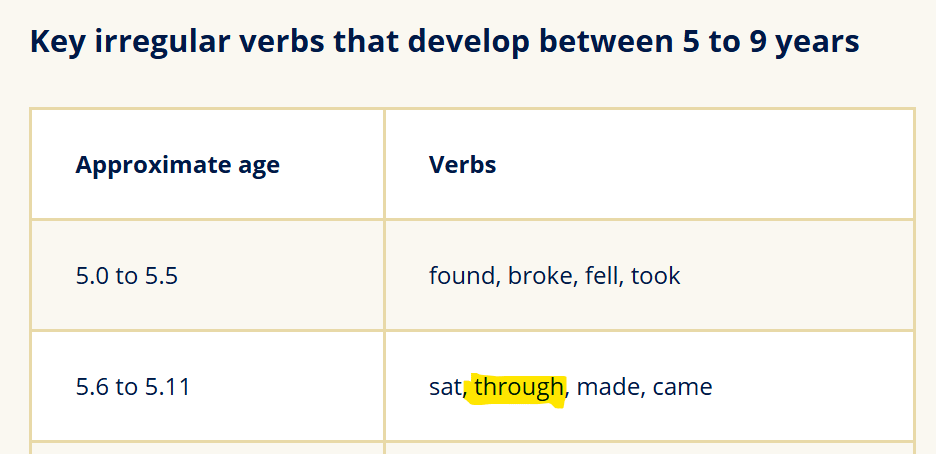
- This one… “through” as a verb? Was this meant to be “threw”?
- Re fluency: “…we encourage our students to make their reading sound like talking…” Oral reading is far more performative than talking to a friend. Oral reading is effectively a form of public speaking. The language of rich texts is also far more sophisticated than the language of a friendly discussion, which inevitably creates far more complex demands on phrasing and prosody. We do kids a disservice by suggesting they should be aiming for oral reading that sounds like talking to a friend.
So, what is right?
The content on Multi Tiered System of Supports sounded promising, but with just 2 terms left of 2026, I’ve not heard news of any public school starting out on genuine tier 3 intervention as a result of the Lifting Literacy rollout, yet. So it seems to be very much a theoretical proposition currently or, at least, limited in reach so far.
And the intent, from DECYP, was right. I’ve now met some of the people driving the rollout and their hearts are clearly in the right place, and they’re committed to changing for the better. I’m not, however, convinced that the intent from within Deakin was aligned; it’s simply quite difficult to imagine that there could be so many fundamental mistakes (which often feature quite convoluted conflations) made about so many fundamentally important concepts, unless there was an element of sabotage involved. If that sounds a bit ‘crackpot conspiracy theorist’ (and I concede it does… and maybe it is… Hanlon’s Razor), check out my critique of Noella Mackenzie’s and Misty Adoniou’s work in Merchants of Illiteracy, and then return and reassess. There’s money to be made by perpetuating the status quo. $1.2 million, in this case.
In Summary
Keep in mind this is just a sample of the problems I noted, not an exhaustive list. And I only got through the modules to the end of year 2 before it wore me down.
This should’ve been an easy project to get right, and one which would’ve had positive intergenerational effects. It required no new technology and no new knowledge. The software cost is negligible, and Australia (and indeed Tasmania) has plenty of expertise in delivering structured literacy.
How we’ve managed to spend $1.2M on a PD delivery that is effectively having to be rewritten at the same time as people are receiving their PD, is a question the public should be asking. But it seems to be a theme… consider the Peter Underwood Centre’s earlier review of literacy instruction that also cost taxpayers just shy of $1M.
Full disclosure: I did apply for a position on the LLOMG but was not successful (in case anyone wants to level a ‘sour grapes’ accusation).