(Is it just horses for courses?)
[Published on Substack July 22nd 2026]
I’ve just had the rather unsettling experience of hearing my own words read back to me, as a result of being quoted in this guest article I listened to, from Jennifer Newman on Harriett Janetos’ substack. Ms Newman traces Diane McGuinness’ sense of mise en place through Linguistic Phonics (‘speech-to-print’).
Amusingly (to myself, at least), it was more the fact that someone was quoting me that was slightly jarring, rather than the fact that words from me, an Orton-Gillingham practitioner, had been used to argue against Orton-Gillingham approaches.
But it’s that latter ‘tension’ that prompts me to write here. It’s not really a tension though, for a few reasons.
Firstly, I’ve argued against the ‘excesses’ of OG-aligned programs myself (and hence my being quoted).
Secondly, while my email signature has “Orton-Gillingham Educator” in it, I am not in the least wedded to OG, and the SLP clinic I work in takes the position that OG is an approach, rather than a program. Which basically means we’re free to use whatever resources we know will help the kid, within a lesson that follows research and sound principles of instructional design. Which means, for example, my ‘OG lesson’ might include a reading game from Little Learners Love Literacy, and letter tiles from Sounds~Write. The shelves in the clinic feature RAVE-O, Multi-Lit, NIfDI, Playberry, SPELL-Links… I doubt I could recall them all if I tried.
Thirdly, I am beginning to be more and more swayed that speech-to-print (or ‘Linguistic Phonics’) is the way to go for most kids.
In short, what I am wedded to, is good instructional design that leads to structured, sequential, cumulative learning. As such, I welcome Ms Newman’s post and the chance to discuss (and I don’t for a minute think she was intending to pick a fight either… but it creates an opportunity to explore some threads that I’ve been spinning in my head).
I wish there was more research on differences in instructional methods like speech-to-print vs. print-to-speech so that we didn’t have to rely on gut feel, anecdotes, and appeal to prima facie propositions.
But that’s all I’ve got, so…
Prima facie propositions
Diane McGuinness’ Why Our Children Can’t Read was one of the very first books I ever read on literacy. I’ve since read her more scholarly duo Early Reading Instruction (ERI) and Language Development and Learning to Read (LDLR), and the subsequent salvos between Charles Hulme and McGuinness. She has influenced my thinking tremendously.
However, as I’ve written in “Why Orthographic Processing is Cwen”, I think (as someone who has designed many-to-many systems – like the English orthography) McGuinness was wrong about the notion of the English orthography being a reversible code (because it’s actually not, by definition; genuinely reversible codes do not feature ambiguity).
I also think that her admirable efforts to lay difficulties in literacy acquisition at the feet of poor instruction rather than ‘weaknesses in the child’ can only be upheld if we ignore the cohort of children who really struggle with literacy, regardless of the instruction.
Where I suspect speech-to-print wins
Being wrong about a reversible code doesn’t mean she was wrong about putting phonemes first, and I think that she was likely right about that for tier 1 instruction. I’m working at tier 3 or, I’d contend, tier 4 (which is a description I’d reserve for the kids who have, say, excruciatingly weak orthographic processing – think 100+ exposures to map a CVC word – or comorbidities such as an auditory processing disorder or childhood apraxia of speech), and the main reason I lean toward print to speech in this setting is because introducing multiple ways of spelling a phoneme at once (or hot on an alternative’s heels), would fry their brains. It already causes a level of outrage when they have to grapple with the fact that there’s more than one way to spell a phoneme, even when they’re introduced to them one at a time, with other phonemes in between, to give opportunity for mapping of words spelt the first way.
But I don’t expect that would be true of most kids. Most kids are excellent statistical/pattern learners. Most kids aren’t weak orthographic processors. Most kids form GPCs quite quickly, unlike those who confuse ‘igh’ and ‘dge’ (true story), let alone ‘au’ with ‘augh’ or ‘aw’. So, I think, for most kids, a speech-to-print (S2P) approach could be far more efficient. This is outside my experience, though, so it’s conjecture on my behalf (but Jennifer Newman certainly makes some good arguments in support – and some less convincing juxtapositions, which I’ll come to).
Where I suspect print-to-speech wins
What isn’t conjecture, though, is my concern about the reluctance of speech-to-print approaches to teach things like ‘spelling rules’ to those kids who need them. I’ve seen the teaching of spelling patterns pay dividends first hand, and there’s research to back it up. I’ve written in depth about why I think this resistance to ‘spelling rules’ is an ideological insistence rather than a research-informed position, in “Spelling Rules. Or Sux.” Sure, if a kid can spell through pattern-learning of the rules, don’t waste the time teaching them those rules. But that’s not all kids.
Jenny Chew also subsequently pointed out to me that despite McGuinness’ exhortation that:
There are no spelling rules. Forget about rules. Forget about generalisations. (ERI p. 44).
…there are other areas where she seems to contradict herself, and then re-contradict herself. Here are some examples:
Patterns within patterns (statistical regularities) make learning multiple spelling alternatives more manageable. Once they are known, they can be taught directly. Exposure (practice) is the key, not rules or memorization… …the complexity is reduced… by memorizing the few words and prefixes where /ee/ is spelled e (be, he, me…)” (ERI pp. 61-2) [While elsewhere she slams the memorisation of ‘sight words’]
For the Latin suffix “shun”:
There are lots of useful clues [clues, dammit, not generalisations!] for these “shun” spellings: when in doubt, spell -tion. If an occupation or person, spell -cian…” (ERI pp. 63-4)
….and so on.
There are transformations for adding suffixes that come very close to “rules”, and when they do, they are well worth teaching, not as rules, but through suitable examples and repetition. (ERI p. 280)
…teachers can move on to say: “There’s another way to spell this sound. I’ll show you how to remember when to use this spelling.” (LDLR p. 5)
Sadly, she didn’t complete that instructional sequence to clarify how a teacher can fulfil a promise to show a child how to remember when to use a spelling, without using a generalisation.
While we’re at it, there’s almost a whole page (p. 70) in Why Our Children Can’t Read in which McGuinness recounts an example of what goes on in her reading clinic:
Teacher: Jake, can you say the first sound in “frog”?
Jake: Frog
Teacher: You said the whole word. Try to say just a little bit of the word “frog”.
Jake: Frog
Teacher: Now try this. Start to say the word “frog” and stop before you finish.
Jake: Frog
Teacher: Say /g/.
Jake: /g/.
Teacher: O.K., now, say “frog” again but don’t say /g/.
Jake: Fro—
Teacher: Very good. Now try to make it even shorter….
…and so on, until Jake at least gets to “fr”.
That sounds a lot to me like phonemic awareness activities going on in the McGuinness reading clinic, and oral-only, to boot. Which she also slams elsewhere.
Don’t get me wrong, this isn’t meant to be an attack (and quite frankly, every time I pick up a McGuinness book, I can’t put it down). It’s meant to be yet another call for nuance, because you can’t resolve all these contradictory pronouncements unless you apply some nuance.
Which brings me to what I do find problematic about Ms Newman’s post. It cites McGuinness’ call to end the reading wars, but in so doing takes a swipe at print-to-speech (“visual”) phonics:
Over twenty years have passed since McGuinness’s plea that we stop fighting “the reading wars” and refocus our efforts on using high-quality applied research to determine which phonics methods work best. Instead of asking how many graphemes should be taught, which ones, and at what pace – questions that only have meaning within a visual-phonics logic – McGuinness demonstrates that a simple shift in perspective can reveal new possibilities.
Similarly, Ms Newman’s table juxtaposing S2P & P2S:
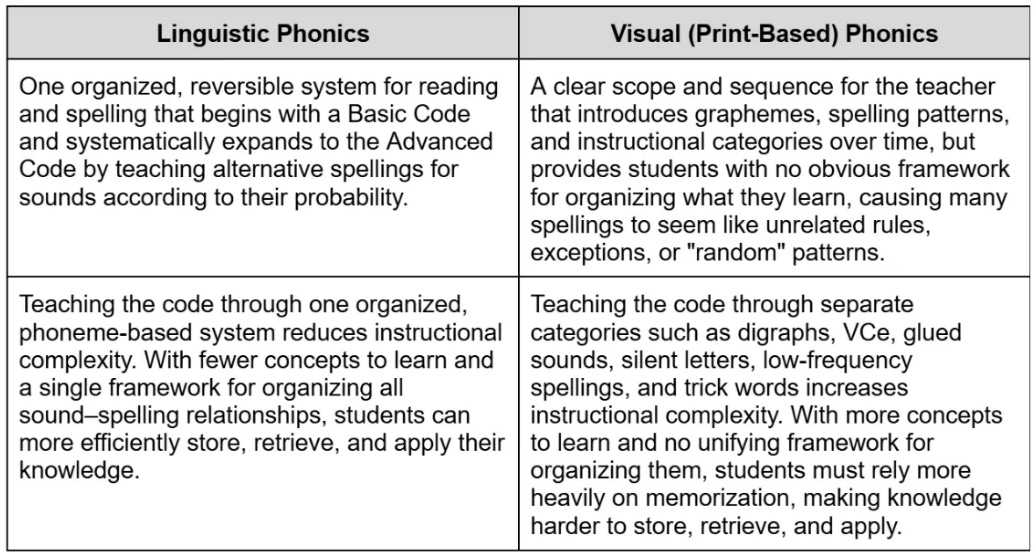
…and list of things for which “there is no need” in S2P approaches, misses the point, from my perspective:
“There is no need for isolated visual or auditory drills or separate phonemic awareness exercises…
There is no need to learn key words, labels for different spelling patterns (e.g., digraphs, blends, long, short, or glued sounds), rules and exceptions, syllable types, articulatory gestures, or sets of irregular ‘trick’ or ‘heart’ words…
There is no need to mark up words with special symbols or work through rigid routines to decode unfamiliar words…
There is no need to wait months before students gain access to multi-letter spellings…”
My objection here – the point I think this misses – is that sometimes there is a lot of need for these things. Let’s stop talking about what instructional components an approach needs, and start looking at what the kid in front of us needs.
The Orton-Gillingham lesson plan template I made includes PA as the first item. It usually remains blank (I’d guess there have been 4 or 5 lessons this year with dedicated PA work). My students learn phonemic awareness incidentally through working with print, most of the time. Because, yes, there’s usually no need for it. Sometimes I do need to teach it separately and explicitly – as, apparently, did the teachers in McGuinness’ clinic.
I do teach spelling rules if it becomes clear the kid hasn’t acquired them by osmosis (as I did). I’ve noted some kids actually delight in them. I usually teach nothing of syllable types beyond the notion of open and closed syllables, and that words can be split in different ways accordingly. I don’t usually mark up words for syllable division, but when a kid just isn’t getting it, marking up syllables is a powerful tool in the toolbox.
I’ve had just two clients (that I can think of off the top of my head) who did need significant support with proprioceptive feedback to support phoneme discrimination.
‘Irregular’ words (some of which McGuinness explicitly recommended teaching, as above) are part of my process, but I minimise them and use strategies (like ‘spelling voice’, morphology, etymology) to avoid it being a ‘memory-only’ process.
I teach kids Latinate words like ‘inject’ – via morphology – as soon as I’m confident they have basic GPCs under their belt. Which also introduces syllables. That can mean they’re learning to read and spell “inject” before they’ve learnt to read and spell “gate”. Unless something in their profile makes that too challenging for them.
Yes, there’s no need for a lot of this stuff, especially at tier 1. At tier 3, it’s a different story.
To mix up the cooking analogy, yes, it’s great to have all the ingredients laid out (and I like to think mise en place captures my approach to tailoring a lesson to a child), but once the student comes to the table, it might become evident that before we can think about laying out the ingredients, the kid may need to be taught how to use a scale, and what a TSP is.
In summary
In short, I’m on board with the idea that S2P / Linguistic Phonics could be a much more efficient approach to tier 1 instruction. But if part of the mantra is to pooh-pooh the tools in the P2S toolbox that can be used to provide more granular, structured support for tier 3/4 kids (and that is the main problem I had with the messaging from Sounds~Write – no other approach was to be used alongside), then count me out.
Similarly, there’s no way – if I ever found myself in front a classroom of kids – I’d be asking all (or, likely, any) kids to do 10-15 minutes of PA, or 10 lessons of place and manner of articulation, or ‘tulip’ syllables. But I’d certainly want those tools in my toolbox for when I needed them. Because some kids would need them. At risk of sounding like Tim Shanahan’s apocryphal OG instructor (“They didn’t look at the right version of OG”), I can certainly see why effectiveness of OG would be low, if practitioners are expected to go into every last bit of minutiae OG offers, for every kid.
But I’d equally expect a S2P approach that forbids, say, the teaching of spelling rules, to not have much success with the cohort of kids who, for example, can’t even accurately copy a sentence of text in front of them.
I don’t think what I’m saying is too different to what Mark Seidenberg has been voicing concerns around: structured literacy was ‘invented for dyslexics’, but not all kids are dyslexic. Not all kids are typical either. So why can’t we just have different courses for different horses?
This all speaks to the need for better teacher knowledge, so that no-one in a classroom is relying on a program, and everyone has the well-founded confidence to give fidelity the flick when required to meet a specific need. Having teachers slavishly roll out Heggerty, or syllable types, to kids who don’t need it, or denying spelling rules to kids who won’t learn to spell without them, is arguably an improvement over asking kids to guess the word from the picture, but we can do much better. And I’m certainly in full support of mandates being program-agnostic.