
…They dined on mince, and slices of quince,
Which they ate with a runcible spoon;
And hand in hand, on the edge of the sand,
They danced by the light of the moon…
[Published May 25th 2026 on Substack]
If you were to consult the Merriam Webster dictionary, you’d find that a runcible spoon is a “sharp-edged fork with three broad curved prongs“. Collins dictionary defines it as a “forklike utensil with two prongs and one sharp curved prong”.
People may argue whether it’s a spork or a splade or something altogether different. But “runcible” is actually a nonsense adjective, which The Owl and The Pussycat author, Edward Lear, also used to describe a number of nouns beside a spoon, including a cat, a goose, a man, a wall, and even the moon.
Usage is a powerful influence on language – to the point that an invented nonsense word can feature in a genuine dictionary entry. I will argue here that something similar is happening, but in reverse, with ‘the alphabetic principle’: a very useful, specific, and important term has become so nebulous and indiscriminately applied that is has become almost meaningless through usage.
My position
I have always understood the alphabetic principle to be a simple but profound fact: that in alphabetic writing systems, letters systematically represent sounds.
The alphabetic principle, in my view, is not a complex idea, but it’s arguably one of the most significant inventions in all of human history (dating back thousands of years to the Canaanites) because, before this happened, writing systems were constrained by representing things other than sounds, which quickly becomes cumbersome. You could draw three oxen if you wanted to record that there were three oxen. But what if you wanted to record 368 oxen, or the colours of those 368 oxen, and the condition they were in, or how they made you feel both exhilarated and terrified when they stampeded over the horizon, kicking their rear heels in the air as the sun’s dying rays streamed in visible beams through the dust clouds they created against an intense purple-orange sunset sky? The alphabetic principle freed us to get that information down with relative ease, because anything you could say, you could write.
The first ‘fully’ alphabetic language was Greek, because they also included letters to represent vowels (that’s the alpha in alphabet[a]), not just consonants.
So… my position is that the alphabetic principle is the principle that alphabetic orthographies use letters to represent sounds systematically.
Let’s have a look at how that holds up. Note I’ve just done some digging in online sources – I think the evolution of the alphabetic principle could make a fascinating thesis, but that’s not what this post is; I’m just scratching the surface.
Pre-Alphabetic Runcible
The American linguist, Charles Carpenter Fries, attributed the first articulation of the alphabetic principle (without it actually being called that) as a basis for instruction to John Hart’s 1570 reading primer, which had the fantastic title A methode or comfortable beginning for all unlearned whereby they may bee taught to read English, in a very short time, with pleasure (which, if you like the look of the Preface below, you can tackle in its original glory here).

Fries notes:
“John Hart’s book of 1570 was the first book in English, so far as I know, to present a textbook from which to teach beginning reading using an alphabet based upon the principle of using “as many letters in our writing,” as there are “voices” or sounds in our “speaking”.
As to the actual term “alphabetic principle”, the earliest appearance I’ve found so far is in 1922, from another American linguist, Leonard Bloomfield, in his book Language:
The chief aim, of course, is literacy. Although our writing is alphabetic, it contains so many deviations from the alphabetic principle as to present a real problem, whose solution has been indefinitely postponed by our educators’ ignorance of the relation of writing to speech.
This text, and Bloomfield’s later instructional Let’s Read: A linguistic approach (which you can still buy!) makes it very clear that for him, the alphabetic principle was a property of writing systems, and its consistency is dependent upon a shallow orthography:
The ancient Greeks seem at some times and places to have reached an almost perfect application of the alphabetic principle and then to have lapsed from it: in medieval and modern Greek writing the alphabetic principle is very poorly carried out.
He even goes so far as to suggest that irregular words don’t adhere to the alphabetic principle:
Our teaching ought to distinguish then, between regular spellings, which involve only the alphabetic principle, and irregular spellings, which depart from this principle, and it ought to classify the irregular spellings according to the various types of deviation from the alphabetic principle.
I’m going to argue that even this 1922 notion of the alphabetic principle sits within the definition of ‘sounds being systematically represented by letters’, because Bloomfield’s only potential departure from that definition is in his concern with the depth/opacity of the orthography, and there’s room for that concern in the systematic feature of the definition. In other words, it’s a fair argument to make (and Bloomfield is making it above, implicitly) that English is not a strictly alphabetic written language because it’s hard to argue that there’s much that’s genuinely systematic about words like “yacht”. I don’t think I would make that argument myself, but it certainly has some merit.
Indeed, I suspect that if I continued to dig deeply enough into the history around these kinds of distinctions – ‘regular’ and ‘irregular’, or ‘alphabetic’ and ‘non-alphabetic’ spellings – I’d find that the notion of orthographic depth was originally introduced as another dimension of the alphabetic principle, likely to avoid the unsatisfactory circumstance wherein a written language could appear to meet criteria to be classified as both alphabetic and non-alphabetic.
Regardless, it seems pretty clear that the alphabetic principle was originally conceived as meaning that, at base, a property of the orthography in question is that letters represent sounds and just how systematically an orthography makes those representations, came to be seen as a feature or failing of the orthography in its adherence to the alphabetic principle.
Enter Liberman and Shankweiler
Their 1989 paper seems to be the point at which the alphabetic principle – a property of an orthography – was first posited as something separate from the orthography: a child’s awareness that needs to be developed.
This wasn’t a subtle shift, and it wasn’t posited as such, either; Liberman and Shankweiler explicitly herald their own understanding of the alphabetic principle as a departure from what many others ‘mistake’ it to be.
Building on Isabelle Liberman’s much earlier discussion (Basic research in speech and lateralization of language: some implications for reading disability 1971) of the distinctions between the demands of speech and reading (which, interestingly, articulated notions that are now commonly attributed to David Geary – biologically primary and secondary skills), Liberman and Shankweiler’s 1989 The Alphabetic Principle and Learning to Read makes a reasonable suggestion: if the possibility of segmenting words into phonemes for written representation was such a difficult discovery for humanity that it was perhaps only made independently once, we shouldn’t expect children to discover it by themselves.
Phonemic awareness, then, came to be included in ‘the alphabetic principle’, and so a principle began to morph into a skill to be mastered:
We begin, then, with the assumption that reading by an alphabetic writing system requires mastery of the alphabetic principle. Surprisingly, this assumption, which seems to us a truism, is not accepted by everyone in the field, as we will see. But even among those who think the principle important, many take it – we would say mistake it – to mean simply an understanding by the would-be reader that the discrete letters of the alphabet represent the discrete sounds of speech. Our view (Liberman, 1983) is different. As we see it, the letters of the alphabet do not represent sounds as such, but rather the more remote phonological (and morphophonological) segments those sounds convey. This is not to quibble. For surely it must be somewhat confusing to children to be told that the word bag is spelled with three letters, when their ears tell them plainly that it has but one sound. The confusion is only worse confounded if the teacher insists, against the evidence of what the child hears, that bag can be divided into three sounds, and that these can then be “blended” so as to re-form the word. For there is, in fact, no way, with or without the marvels of modern technology, to divide bag into pieces of sound that correspond in any reasonable way to the sounds of the three letters, nor is there any way to synthesize the word by somehow putting the letter sounds together. Though bag does truly consist of three segments – it differs from sag in the first, from big in the second, and from bat in the third – these segments are to be found only in the underlying phonology, not in the surface appearances of the sound.
This is a fair point, and it is indeed not quibbling. But it is, I’d suggest, more problematic than quibbling. It seems to me to be stating one of two things:
1. An unthinkable straw man
At face value, these statements suggest a distinction in views that doesn’t exist.
On first reading, I couldn’t make sense of the “our view is different” statement unless the authors are suggesting that when some people speak of an alphabet representing “discrete speech sounds”, those people are not referring to representing phonemes, as opposed to larger discrete units of sound (like words). This is difficult to accept.
While the linguistic concept of a phoneme was developed in the late 1800s, we’ve been working with the inherent idea of phonemes ever since the invention of alphabetic writing systems, in the same way that the idea of gravity was developed scientifically in the late 1600s, but we’ve been working with levers and wheels to move heavy things for a long time before that. And so, it would be a strange claim for a 20th Century engineer to declare that their view of Archimedes’ Principle is different from that of others’ because the weight of displaced fluid isn’t just about weight, but also about gravity. In other words, just because gravity wasn’t formalised for thousands of years after Archimedes’ Principle, doesn’t mean that everyone who spoke of Archimedes’ Principle wasn’t actually speaking about gravity, inherently.
Such a suggestion would seem to be a straw man argument: I’ve never come across anyone (contemporaneous or historical) who refers to an alphabet as representing speech sounds, for whom “sounds” doesn’t mean phonemes. After all, that’s what defines an alphabet: it has letters that represent phonemes. Not syllables, not words, but phonemes. The revolutionary invention of the Canaanites was to represent consonant phonemes, thousands of years before Liberman and Shankweiler suggested that their understanding of the alphabetic principle is different to those who think it ‘simply’ means that discrete letters represent discrete sounds of speech.
Given the calibre and erudition of these researchers (notwithstanding Dianne McGuinness’ contention that Liberman is partially responsible for a dogma within the field, around the developmental nature of phonological awareness), it seems absurd to suggest that they’d have built such a straw man. Which leaves the second option.
2. Spooky phonology
Given the focus of Liberman’s work, it seems far more likely that the real difference they refer to is encapsulated in the last sentence: “these segments are to be found only in the underlying phonology, not in the surface appearances of the sound.“ That is, for Liberman, the notion that letters represent sounds is an over-simplification. And it is.
I’m in total agreement that the notion of a phoneme may cause some kids great difficulty because, as Mark Seidenberg succinctly put it, phonemes are ‘convenient fictions’ which don’t actually exist as individual entities in a spoken word. Our spooky ability to bridge the gap between the artificial combination of these fictional units and an actual word is indeed a skill and one which varies between individuals (and forms part of set for variability). It is what underlies the existence of the alphabetic principle, but it need not be a part of the alphabetic principle.
No kid needs to ‘master’ the nuances of phones, phonemes, allophones – knowing which are real and which are ‘invented’ – and how they fit in words. They need to know that the sounds in words can be represented by letters, and that by doing so, other people can read those letters as words. They don’t need to know that alphabetic systems are actually based on an artificial abstraction. Nor, it must be noted, did the people who actually invented alphabetic writing systems. They didn’t have access to spectrograms to understand that words aren’t really made of phonemes. But they managed to invent the systems anyway.
All this meta-level understanding about phonology is well outside the scope of what the alphabetic principle needs to be, and the notion of “mastery” of the alphabetic principle starts to skew a fact into being a skill.
Looking at it another way, using Liberman and Shankweiler’s scenario, if it causes a kid confusion to tell them they can split bag into three sounds, I’d contend there are very good odds it’ll cause them even more confusion to tell them that when we say bag, it’s one sound and we just pretend it’s made of three distinct phonemes, even though we’ve really made up the phonemes and that they actually can’t even join up to make the word, and we did that just so that we can use letters to write those sounds down, and despite the sounds the letters represent not being able to join up and make a word, our brains are so good at language that we can recognise the word we’re trying to build anyway, but only if they learn how to pretend that sounds are made of other sounds we’ve invented.
That’s all true, but I’d suggest it could be a hard sell to kids.
I am, of course, being a bit facetious. It could arguably be a good idea to explain alphabetic systems in exactly that way, but in a simplified form, especially to those kids who notice themselves that coarticulation bends the rules – and I often find myself doing so with tier 3/4 kids.
Regardless, despite the authors’ claim of difference (and despite their work demonstrating the difficulty a lack of PA brings), I don’t see this paper as adding anything definitionally to the alphabetic principle, except that it effectively reverse-engineers a millennia-old idea with modern tools to demonstrate that its creation actually relies on a skill (PA) that the alphabetic systems demand. This perhaps should not be surprising, no matter how interesting.
While the ‘mythical’ nature of the principle that alphabet letters represent speech sounds is fascinating to consider (and instructionally useful for teachers to be aware of), the real difference I see in this paper is that it laid the groundwork for a burgeoning category error: an orthography’s property being conflated with the requisite skill involved in creating and navigating that orthography.
Ehri’s alphabetical order
The alphabetic principle became more nebulous again with the birth of Linnea Ehri’s phase theory of reading development – through no fault of Ehri’s. The alphabetic-referencing phases (“pre-alphabetic”, “partial-alphabetic” etc.), seemingly just by dint of sharing the same word, “alphabetic”, lent themselves to conflation with the recently modified (Liberman/Shankweiler) alphabetic principle/awareness. That is, not only does the alphabetic principle mean you need some PA to be able to work with it, you also need developing knowledge about the principle to be able to work with it (which is all true, but it’s not what the alphabetic principle means… unless we just accept that it is, as we can accept that a runcible spoon is a thing).
I’d contend that we can see this conflation of ideas very clearly in Buckingham et al. (Systematic and explicit phonics instruction: a scientific, evidence-based approach to teaching the alphabetic principle, 2019):
According to Ehri (2005), development of the alphabetic principle occurs in four phases.
I’d argue this is a conflation because in Ehri’s 2005 Learning to Read Words paper which Buckingham et al cited to support this statement, Ehri never even so much as used the term “alphabetic principle” – not once in the entire paper – let alone reframed the term on a developmental basis. Ehri certainly refers to alphabetic knowledge and knowledge of the alphabetic system, but not to the alphabetic principle.
Ehri’s phase theory of reading development certainly suggests that a child’s understanding of the practical implications of the alphabetic principle develops over time, as does their knowledge of the alphabetic orthography itself, but that growing understanding of the implications of the principle is not what the principle is,nor do kids actually have to know what the alphabetic principle is, to read (though I’d suggest it’s worthwhile teaching, to ensure kids have the opportunity to learn it from explicit instruction, and not just divine it). I guess it’s possible Ehri might decide to bundle her phase theory into the alphabetic principle in the same way Liberman bundled her contentions about PA into it, but if Ehri has made that attempt in the literature, I haven’t come across it yet (perhaps someone could point me to it).
It’s been others who have bundled all the alphabetic-bits of reading research into the alphabetic principle.
Wolves and possums
In looking for other interpretations and evolution of the alphabetic principle, I noted that Maryanne Wolf’s RAVE-O program has elevated its importance.
In an early version of RAVE-O in the clinic I work in, the possum acronym actually demotes the ‘u’: POSSuM, giving the impression it’s there purely to make a word – and the graphic explicitly shows it stands for… nothing.
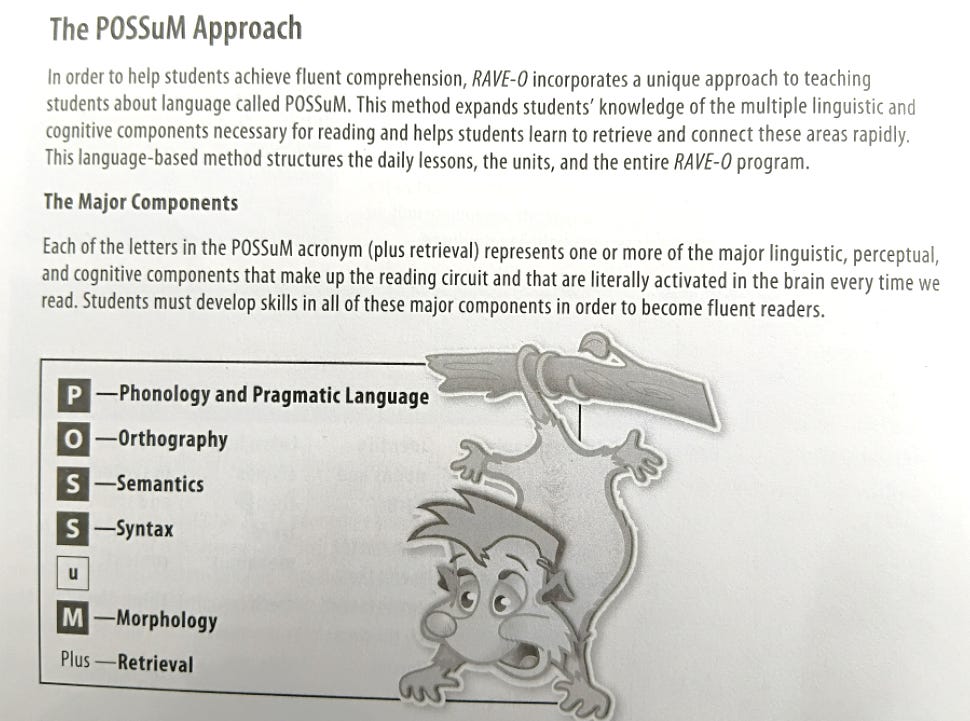
The current version of RAVE-O has apparently assigned that loafing “u” a job. It’s now “understanding the alphabetic principle”, which seems a very concrete demonstration of an understanding of the alphabetic principle becoming regarded more and more as a skill to be explicitly taught; it wasn’t mentioned in the earlier iteration, yet gets its own place in the acronym in the current version.
Well, it could demonstrate the principle is indeed morphing into a skill, or that the principle is now considered more important to a research-based program, or that the lowercase ‘u’ was just bugging the authors and they saw an opportunity to ‘fix’ it:
“Specifically, RAVE-O is the only program to simultaneously integrate phonology, orthography, semantics, syntax, understanding the alphabetic principle, and morphology with the same words. Of equal importance, these same words are then used in the context of stories (connected text) with their multiple meanings and uses. We call this approach POSSUM…“

There’s obviously nothing wrong with a program evolving in line with an evolving research base, but in the case of the alphabetic principle, I question whether the evolution of this idea is progressive or regressive. For anyone with access to the newer version, I’d be very interested to see how the RAVE-O curriculum teaches an ‘understanding of the alphabetic principle’ as it applies to word study, that the other components don’t already teach.
Qualiteach’s alphabetic runcible
This is what originally pushed my buttons on this front. Qualiteach is DECYP Tasmania’s online professional development content for literacy instruction, which came from the Lifting Literacy reforms.
Depending on when a teacher accessed Qualiteach, this is the definition of the alphabetic principle they may have found:
Student’s [sic] understanding of the alphabetic principle develops over time and has been described in a number of phases… In parallel with students developing phonological and phonemic awareness skills, they develop knowledge of the alphabet symbols used to represent these sounds. Ehri called this growing print awareness the alphabetic principle. The alphabetic principle is the ability to recognise and name both uppercase and lowercase letter symbols when printed and to name the common sound associated with the letter or single graphemes. This is a key skill that is essential for word recognition and therefore reading comprehension success.
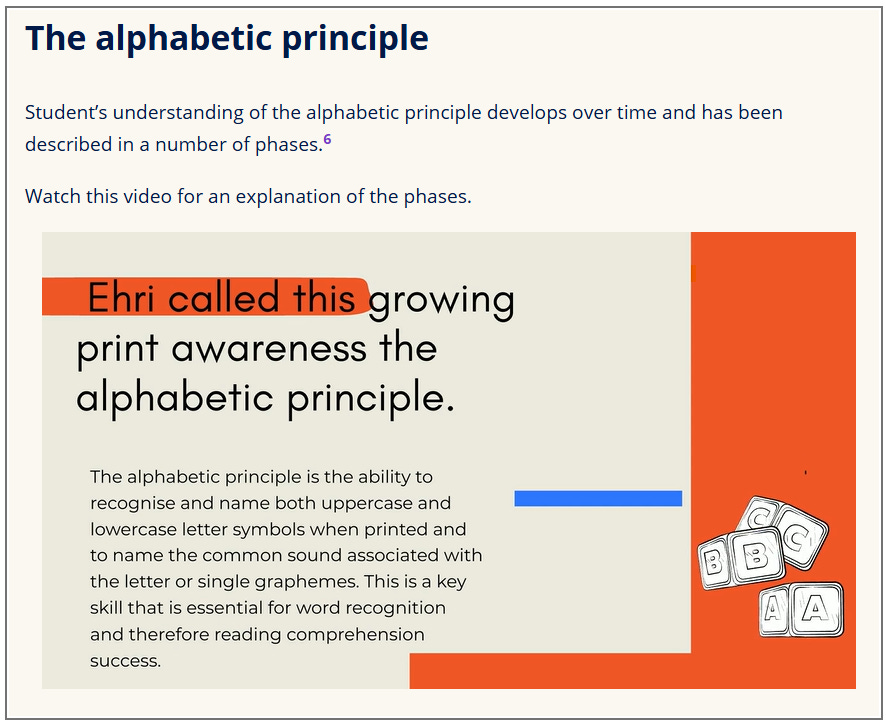
There are multiple problems with that one slide, but for this post I’ll focus on the fact that we have the alphabetic principle being conflated with both print awareness and Ehri’s phase theory of reading development.
The conflation of the alphabetic principle and Ehri’s phase theory can be traced to Buckingham et al (discussed above – though as we’ve seen, Ehri certainly didn’t coin the term ‘alphabetic principle’), but the alphabetic principle is not“the ability to recognise and name both uppercase and lowercase letter symbols when printed and to name the common sound associated with the letter or single graphemes”; you don’t need to know the name of a letter to use it reliably.
Conversely, kids could potentially recognise and name letters and know the sounds they represent, and use this knowledge to read accurately, and still not have a clue what the alphabetic principle is, despite being able to demonstrate a working knowledge of an alphabet. Such kids would be skilled in their application of the alphabetic principle, with only a tacit understanding of the meta-concept of the alphabetic principle. In other words, you don’t actually have to know what the alphabetic principle is, to be an expert reader – as seemingly, ironically, demonstrated by the Qualiteach authors.
On the other hand, given the ongoing ‘evolution’ of the term through usage, who’s to say that this spiel about the alphabetic principle isn’t as valid as any other? And that’s my point. If a term becomes so over-used, conflated and nebulous to seem near-mystical, and begins to funnel-in pretty much any concept that has anything to do with an alphabet, when does it cease to become useful?
Here are some quiz questions I encountered as I worked through the modules:
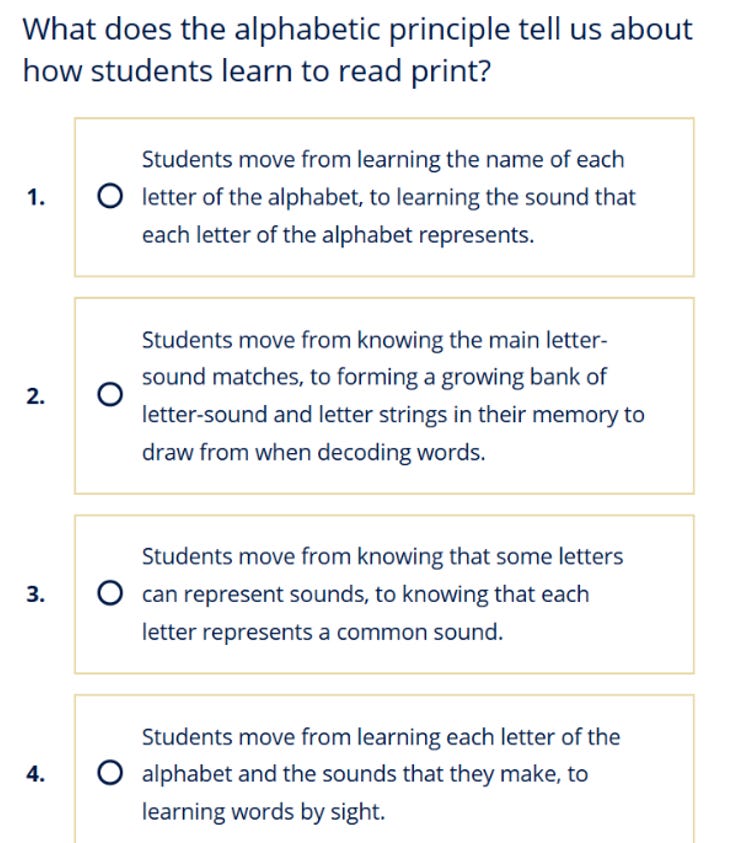
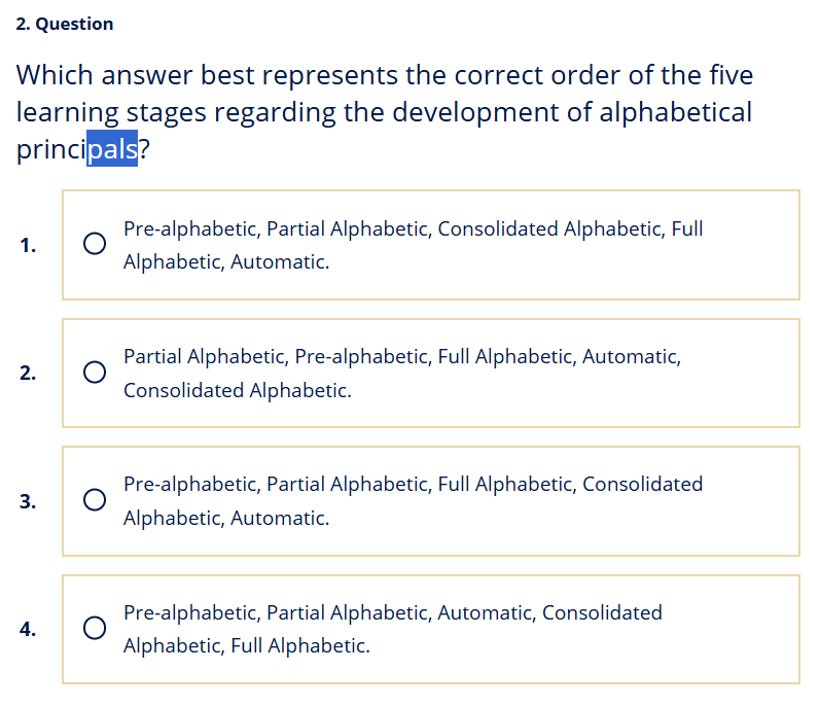
Then there’s the question Qualiteach left its participants with for reflection:
How do we as educators develop students’ alphabetic principle?
Runcible ruminations
Even if we accept the ‘evolution’ of the term, as Hobart psychologist and literacy specialist Michelle Chadwick noted as we discussed what an understanding of the alphabetic principle means, “I think we are wading through deep epistemological/linguistic weeds here”.
I must acknowledge Michelle’s influence in this piece, since (in personal correspondence) she challenged my original claim (despite being in partial agreement) that the term is being misused, which forced me to dig deeper, called out my sloppy framing of declarative and procedural knowledge equating to understanding, and pointed me to some new research (discussed in closing). She also pointed out that I’ve been erroneously referring to “set for variance” rather than “set for variability”, which is particularly ironic in a post calling for accuracy in terminology.
I had commented that to understand the alphabetic principle, you have to both know it (declarative knowledge) and be able to put it into practice (procedural knowledge), which Michelle corrected by noting:
I don’t think understanding AP is covered by procedural habits required by the principle. I don’t think you can reduce any understanding to declarative knowledge plus procedures, or to just the procedures themselves.
You can think of understanding as a schema: schemas are mental frameworks or cognitive structures that help individuals organize, interpret, and understand information and experiences.
To use maths as a parallel, research shows that conceptual understanding and procedures develop in tandem. That conceptual understanding can be measured by declarative knowledge and procedures, but that is not what the understanding is.
I had to concede that I’d been sloppily reductionist, and I concur that this is a case where the whole is greater than the sum of its parts (or at least its more obvious parts). But I also think that for instructional purposes, it’s far safer to focus on the parts to develop the whole, and we agreed that ‘alphabetic principle’ is snowballing, picking up stuff far removed from its origins.
Michelle sees value in the concept of understanding the alphabetic principle as something beyond just the idea that letters represent sounds. She sees that the ability to work with the abstractions of phonemes is so fundamental to the existence of the alphabetic principle that it needs to be given a place, even if only to break the curse of expertise; just because we expert readers can say and understand that ‘letters represent sounds’ doesn’t mean that kids will, when we tell them that – following Liberman and Shankweiler.
I agree with that. But I’m not convinced we should bundle that up with a term that already had a distinct meaning, rather than calling it something else (how about phonological/phonemic awareness – would it be more appropriately bundled there?)
On reflection, my Archimedes’ Principle analogy is flawed on at least one level. The relationship of gravity to Archimedes’ Principle may well be similar to the relationship of phonemic awareness to the Alphabetic Principle, but the enormous difference is that all kids experience and work with gravity, from birth, while phonemic awareness in service of the Alphabetic Principle is a totally foreign concept to many kids starting school. We are, perhaps, doing something closer to trying to teach kids born in weightless space about both gravity and Archimedes’ Principle. This is indeed something that we should be going back to first principles to teach. But, in doing so, and in referring to that work, would I want to define gravity as part of Archimedes’ Principle? No. And I certainly wouldn’t want to combine any other stuff related to bath water (rubber duckies, soap bubbles…) as part of Archimedes’ Principle.
A recent study suggests that ‘knowledge of the alphabetic principle’ (KAP – an acronym that must have made the POSSUM authors scream into a pillow, after thinking they finally sorted out their loafing ‘u’) is a very strong predictor of reading success, and makes several statements that challenge my position on how ‘the alphabetic principle’ should be defined:
KAP is typically defined as the understanding that “letters represent the phonemes in speech”… …Remarkably, nearly all authors use similar wording when defining it, such as “discovering,” “mastering,” or “grasping” the alphabetic principle. Referring to it as a “principle” may have inadvertently reinforced the notion that knowledge of the alphabetic principle is all-or-none.
Note, again, that ‘knowledge of the alphabetic principle’ is a different phrase to Ehri’s ‘knowledge of the alphabetic system’. Whether we should treat these phrases interchangeably is a decision that should not be made lightly.
Given how the study authors assessed KAP, I’d contend that, once again, we have a conflation:
Knowledge of the alphabetic principle (KAP) was assessed using a subtest in which children were presented with a series of five letters on each trial (e.g., m, n, b, d, f) and asked to circle the letter corresponding to the initial phoneme of a word read aloud by the teacher. To succeed, children needed to identify the initial phoneme of a spoken word, retrieve its corresponding grapheme, and select it from a set of distractors. This task thus goes beyond simple letter knowledge, entailing some minimal phoneme identification skills and an understanding of the alphabetic mapping.
Phonemic awareness is included here as KAP, following Liberman. But a knowledge of specific grapheme-phoneme correspondences is not, in my mind, a knowledge of the alphabetic principle. Being successful at this task certainly involves a tacit understanding of the principle, and it also involves knowledge of a particular alphabet. But that is a specific knowledge, separate to knowing that in an alphabet, letters systematically represent sounds.
Further, the paper’s discussion avoids any conflation of KAP with Ehri’s phase theory of reading, but itself suggests two phases:
Our findings call for a conceptual refinement of KAP. Traditionally treated as a binary skill… our data show that KAP functions as a continuous variable. Each additional point on the KAP scale is associated with better reading outcomes one year later.
We propose two stages in the development of KAP and its contribution to reading acquisition. In the first stage, children grasp that written language encodes speech at the phoneme level – a foundational insight that can emerge before full mastery of letter-sound correspondences, but is progressively deepened by each new mapping acquired. This stage does not necessarily involve decoding. In the second stage, as KAP strengthens, children learn to combine letter-sounds into syllables and understand the context-sensitive nature of some correspondences (e.g., digraphs and trigrams).
In my view, this stage 1 is indeed the alphabetic principle – knowledge of a fact – while stage 2 is more like putting the fact into practice, which is certainly an entirely different kettle of fish. But it is, I’d argue, conflating other concepts yet again. For example, understanding “the context-sensitive nature of some correspondences (e.g. digraphs and trigrams)” comes about through:
- being taught about concepts like “soft c”, and that “dge”=/j/, or
- not being taught about these, but ‘picking it up’ anyway.
The latter requires – at least – being a good statistical learner and a good orthographic processor. Under the former, because you’ve been taught, you don’t have to be a good statistical learner to get a start on working with the context-sensitive nature of the orthography, but you do still have to be a good orthographic processor to map words. So we’re now calling orthographic processing part of the Knowledge of Alphabetic Principle.
I think that’s just as troubling a conflation, or even more so, because orthographic processing is a fairly immutable part of a kids’ profile. Calling it ‘knowledge’ suggests you can address it by instruction, and so far I’ve seen no evidence that you can, beyond the initial gains you can achieve with an absolute beginner or instructional casualty. That is, if you have a kid with low orthographic processing ability, it won’t matter how much alphabetic knowledge you impart, they’ll still have low orthographic processing. It’s very little to do with knowledge, nor practice beyond the basics.
I do think orthographic processing is vitally important in the literacy picture, as I’ve written elsewhere, but if we’re going to conceive of KAP as understanding the context-sensitive nature of the orthography and digraphs and trigraphs then, again, when does it end? Does a kid’s capacity to cope with orthographic depth constitute part of KAP? Does the number of repetitions required for a kid to orthographically map a word constitute part of KAP? Does a kid’s graphotactics knowledge constitute part of KAP? Does being able to recognise a misspelling constitute a part of KAP?
If so, why wouldn’t we also class RAN-letters as part of KAP? RAN-letters certainly affects how well kids can work with sound-symbol correspondences, which is apparently a measure of KAP, so why isn’t it also bundled into it? (Which, incidentally it may well have been in this study, as RAN alone wasn’t controlled for.)
Or, putting it another way, can we just be done with it altogether and say a kid’s ‘mastery of the alphabetic principle’ just means how good they are at literacy?
That seems to be where we’re heading.